
are schools still programming the future?
When the industrial knowledge model collides with a world that no longer runs on it.

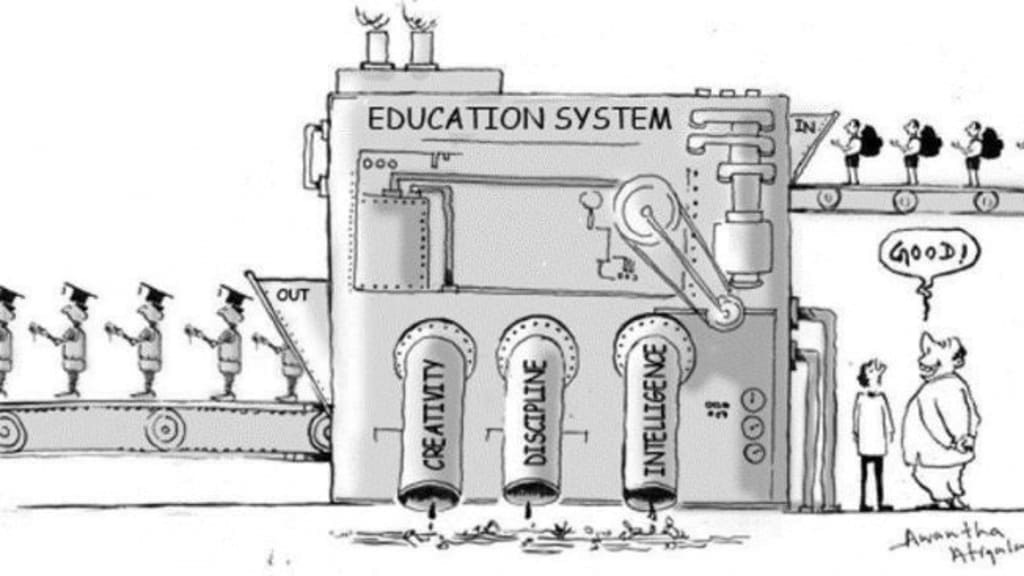
In the free edition, I argued that schools may be obsolete—not as buildings, but as knowledge models.
In this paid edition, I want to go one layer deeper.
Because schools were never only about knowledge transfer.
They were ‘meaning infrastructures’.
They told us:
– what counts as legitimate knowledge
– what qualifies as intelligence
– what deserves authority
– what leads to status
– what is worth memorising
– what can be ignored
Schools did not merely prepare workers.
They calibrated reality.
If you are responsible for talent, leadership pipelines, or institutional design, this is not an abstract cultural observation.
It is a structural issue.
The way schools encode meaning directly shapes how organisations hire, evaluate, and reward competence.
I work at the level of meaning systems—where cultural reasoning becomes an operational structure. If these questions intersect with your organisation’s strategic challenges, you can reply directly. This is precisely where advisory work begins.
the industrial knowledge contract
The industrial school operated on a coherent contract.
Knowledge was scarce.
Institutions curated it.
Teachers transmitted it.
Exams validated it.
Degrees certified it.
Employers trusted it.
The model aligned with industrial society because industrial society required:
standardisation
predictability
hierarchy
role clarity
delayed reward
The classroom mirrored the factory.
The timetable mirrored the shift.
The curriculum mirrored disciplinary silos.
The diploma mirrored institutional authority.
Meaning was centralised.
what broke is not content—but coherence
Today, knowledge is abundant.
Access is decentralised.
Expertise is distributed.
Learning happens continuously and informally.
Yet schools still operate under the industrial contract:
You attend.
You comply.
You pass.
You graduate.
You are prepared.
Prepared for what?
The misalignment is not merely economic.
It is epistemological.
The World Economic Forum’s Future of Jobs Report (2023) lists analytical thinking, systems thinking, resilience, and complex problem-solving among the fastest-growing skills globally.
These are not subject-bound competencies.
They are integrative capacities.
Meanwhile, OECD research shows that technical skills decay faster than institutional cycles adapt. In fast-moving sectors, the half-life of certain skills is measured in years rather than decades.
Work no longer functions in silos, yet education still teaches in silos.
Organisations reward synthesis, yet schools assess isolation.
Real problems are ambiguous, yet exams reward precision detached from context.
The issue is not that schools teach outdated facts.
The issue is that they still encode stability in a world structured by acceleration.
